A Five-Minute Comparison of Two Similar Packs
Compare two similar food packs by matching the amount, intended use and practical details, so you can choose what fits tonight’s meal without overthinking.
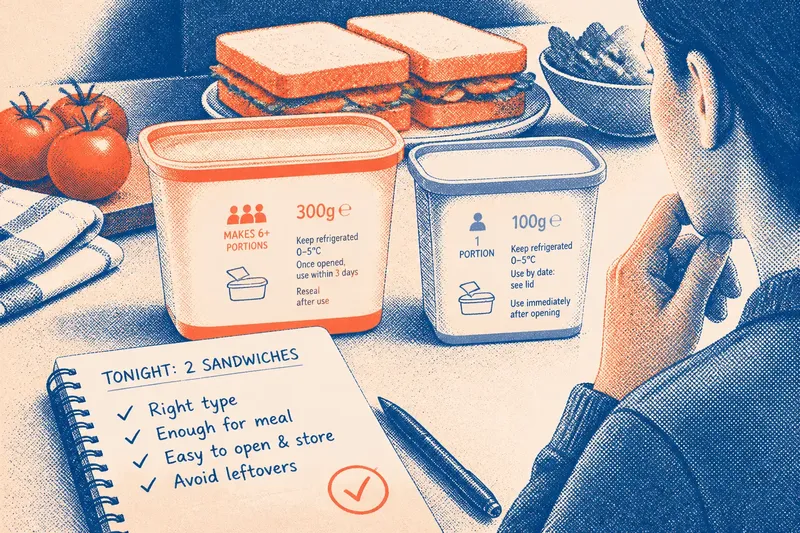
Which of two similar packs will suit tonight’s meal without leaving you with food you will not use? A five-minute comparison of two similar packs works best when you begin with the meal, then check the amount, format and practical handling that affect whether each pack will fit.
Keep the front labels face down for a moment. Name the job—such as filling two sandwiches, adding to a sauce or packing a snack—and compare the packs against that job, rather than judging them as abstract products.
Start with the meal and the amount you need
Write the meal’s requirement in plain terms: enough for the sandwiches, a small addition to a sauce, or something that can be divided between lunches. Then look at the net quantity and any serving information on each pack. These details help you judge fit; they do not need to become a complicated calculation.
Check whether the products are actually comparable. A plain version and a seasoned one, or a spread and a sliceable product, may look similar on the shelf but serve different purposes. If one would require an extra preparation step or change the dish, account for that before choosing.
Say you need a filling for two sandwiches and are comparing two tubs of the same general type. Imagine—using invented pack details—that one tub is labelled as enough for several portions while the other is described as a single-serve option. You check the quantity and format, then decide the larger tub is the more practical fit if you can use or store the remainder; if not, the single-serve pack avoids an unwanted leftover.
Compare how each pack fits your routine
Think about what happens after you open the pack. Does it need to be transferred to another container, used promptly according to its instructions, or kept in a particular place? Read the storage guidance and opening instructions on each pack, then consider whether they fit your plans.
Packaging can also affect everyday use. A resealable pouch may be easier to put away than a tub without a lid, while a rigid container may be simpler to stack in a crowded cupboard. These are practical differences, not proof that one food is better overall.
- If one pack gives a clear storage instruction that fits where you keep food, choose it if easy storage is your priority; otherwise, favour the pack whose instructions suit your available space.
- If you will use the whole pack for the meal, choose the format that is easiest to open and serve; if you expect leftovers, choose the one you can close and store as directed.
- If the packs are different sizes, choose the amount closest to what you will use when avoiding leftovers matters; if keeping extra is useful, choose the larger amount only if its storage guidance fits your routine.
- If one product needs preparation you do not have time for, choose the ready-to-use option for a quick meal; if preparation is part of the plan, compare the products on the final dish instead.
- If a pack’s instructions are unclear for your intended use, check the maker’s information before relying on an assumption; if the uncertainty remains important, choose the pack with clear directions.
- If the products are different formats, choose the one suited to the recipe you are making; if either format would work, let amount and handling decide.
Use the front label as a pointer, not a verdict
A badge or phrase may draw your eye, but it need not decide between two packs. Ask whether the feature it describes changes the meal, preparation or handling you have in mind. If it does not, set it aside and return to the details that affect your actual use.
Nor is it worth the effort to decode every decorative phrase when neither pack’s wording affects your choice. If a particular claim is central to your decision and the pack does not make its meaning clear, check the manufacturer’s explanation rather than guessing.
How do I compare packs when the details differ?
Should I choose the larger pack?
Choose it if you can use or store the extra food as directed and the larger amount suits your plans. If the remainder would be inconvenient, the smaller pack may fit the meal better.
What if the products are not exactly the same type?
Compare them by the dish they need to serve, not by appearance alone. If one format or flavour would change the result in a way you do not want, rule it out for this meal.
How should I handle unclear storage directions?
Check the manufacturer’s information, especially if the directions affect how you plan to keep an opened pack. If you still cannot tell what is appropriate, choose another product or seek qualified food-safety advice rather than improvising.
What if both packs seem equally suitable?
Use a small practical preference, such as the easier format to store or serve. If those details are also equal, either pack may meet the meal’s needs.
Choose on the details that change the meal
For a five-minute comparison of two similar packs, settle the decision with a short order: confirm the product type, check the amount, consider how you will open and store it, and set aside details that do not affect your plan. This keeps the choice focused without turning a routine shop into a scorecard.
If both options fit, choose the one that makes tonight’s meal simpler. A useful last check is whether you can explain the choice in one sentence—“This is the right amount and I can store what remains”—because that points to a practical reason, not a persuasive-looking front label.