Why Ingredient Lists Begin with the Biggest Share
Ingredient list order shows which ingredients make up the largest shares, helping you compare similar foods while recognising what the label leaves out.
Why does the first ingredient on a food label matter? Ingredient list order usually runs from the ingredient used in the greatest amount to the one used in the least, so the opening entries offer a quick sense of a product’s composition. That is useful when comparing foods, but the list is not a recipe and cannot tell you every detail about proportions, processing or the finished food.
What does the order of ingredients tell me?
The order tells you how ingredients rank by weight when they are used to make the product. The first ingredient contributes the greatest amount by weight; later ingredients contribute progressively less. This is a relative ranking, not a set of quantities.
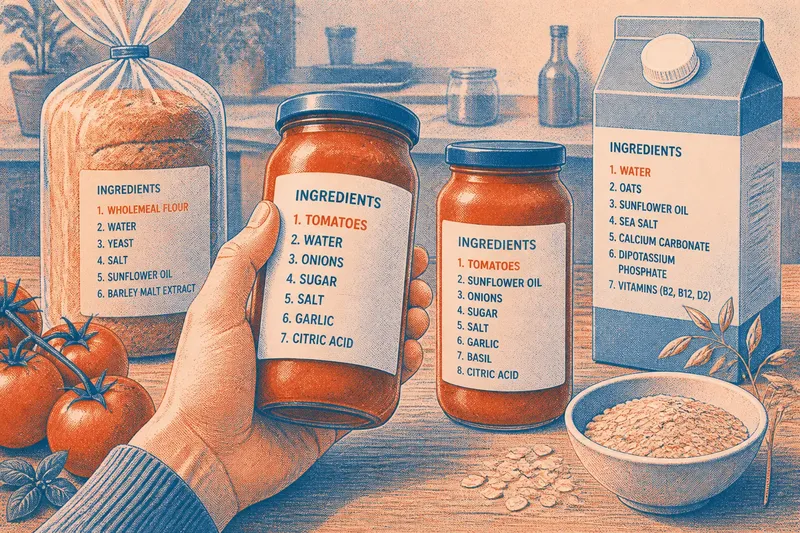
Imagine two tomato sauces both list tomatoes first. That tells you tomatoes outweigh each other listed ingredient in each sauce, but it does not tell you how much tomato either contains. A sauce with tomatoes followed by water may have a different composition from one with tomatoes followed by oil and herbs, even though both start with the same word.
Use the opening entries to form a broad impression, then read the rest of the list for ingredients that matter to your choice. If you are comparing breads, for instance, seeing wholemeal flour near the start of one list and refined flour near the start of another tells you something useful about their main ingredients. It does not, on its own, establish which bread best suits your needs.
Why are ingredients listed by weight?
Weight provides a consistent basis for ranking ingredients in a mixture. Volume can be misleading: a spoonful of a light, airy ingredient and the same volume of a dense ingredient do not contribute the same mass. A weight-based order makes the label’s ranking more meaningful than simply listing ingredients by how much space they occupy.
The list reflects ingredients as they are added for the product’s manufacture, subject to the relevant labelling rules. Some ingredients change during cooking or processing. Water can evaporate from a loaf or sauce, for example, so the order is not a direct description of the finished food’s exact proportions after processing.
This distinction is handy when looking at foods that are baked, dried or cooked. A raw ingredient may have been added in substantial quantity and then lose moisture; another ingredient may remain comparatively concentrated. The label still gives you the prescribed ingredient order, not a calculation of the final product’s composition.
Can the first ingredient show how much of it is in the food?
No. The first position identifies the largest ingredient by weight, but it does not state its share. The second ingredient could be close behind or present in a much smaller amount; the order alone cannot distinguish between those possibilities.
Some labels provide a percentage for a featured ingredient, often because it appears in the product name or is emphasised on the packaging. That declared amount can offer more precise information than position alone. If no percentage is given, do not try to infer one from the spacing, number of ingredients or place in the list.
Nor does a short ingredient list automatically mean an ingredient is present in greater quantity. A product with a few components may still contain only a modest amount of its first ingredient, while a longer list may include several seasonings or minor components. Order ranks; it does not measure.
Why can a small ingredient appear near the end?
An ingredient used in a small amount generally appears later in the list, but its position does not tell you whether it is irrelevant. A flavouring, raising agent, colour or preservative may be present in a small quantity and still have a specific purpose in the food.
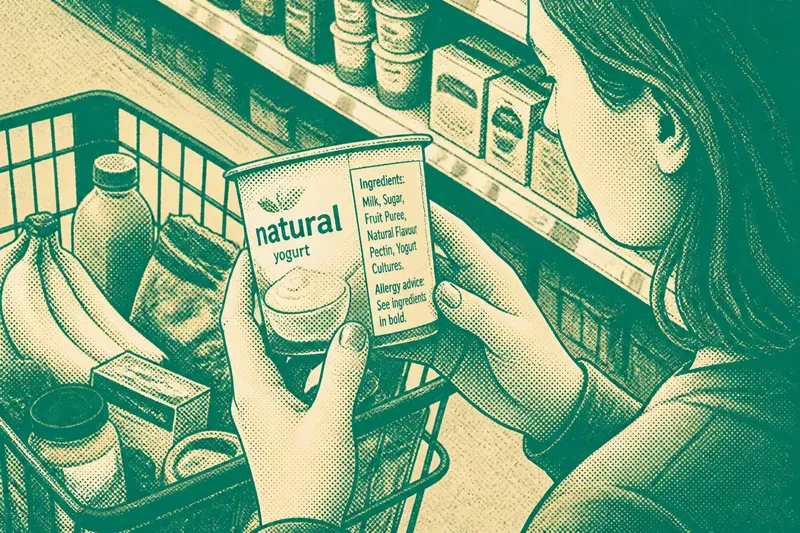
For a reader avoiding a particular ingredient, a late position is not a reason to overlook it. Scan the entire list rather than stopping after the first few entries. A small amount may still matter for an allergy, dietary restriction or personal preference, and the ingredient’s role cannot be judged from rank alone.
Ingredient names can also be grouped or described in ways that are not immediately familiar. If a label is unclear about an ingredient that matters to you, check the manufacturer’s information or ask a qualified professional when the question concerns an allergy or medical diet. The order is a guide to relative weight, not a safety assessment.
What can ingredient order not reveal?
It cannot tell you the exact amount of each ingredient unless the label separately declares that information. It also does not explain why an ingredient was chosen, how it was processed, or how the finished food tastes and behaves. Those questions may call for other label details or information from the maker.
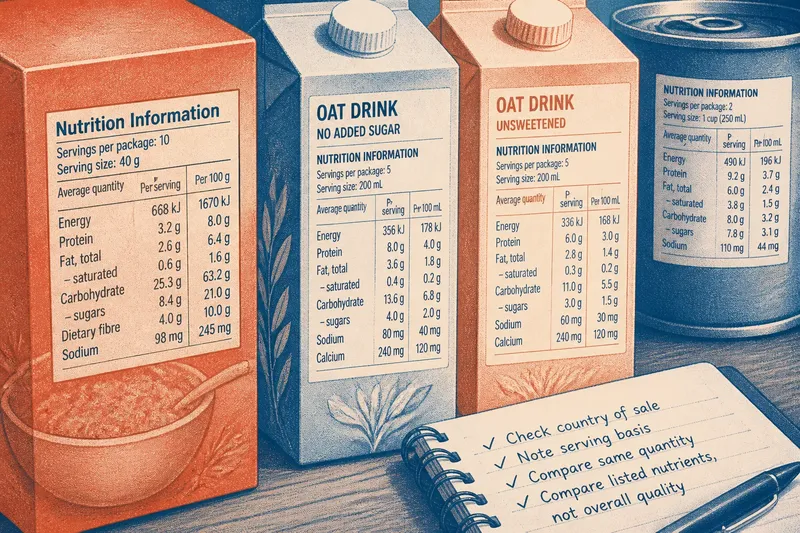
The list does not give a complete picture of nutrition, either. Ingredients are not ranked by calories, sugar, salt or nutritional value. A product’s nutrition panel addresses different questions, so use it alongside the ingredients when you are comparing those features.
Order also cannot settle a broad judgement such as whether a food is “good” or “bad”. The same ingredient may serve different purposes in different products, and people make food choices for different reasons. A list can help you understand what went into a product; it cannot make the choice for you.
How should I compare two ingredient lists?
Start by comparing products that serve a similar purpose and are presented in similar forms. Then look at the first few entries to see whether their main ingredients differ. Read through the whole list for any ingredient you specifically want to include or avoid, and check for a declared percentage if the packaging highlights a particular ingredient.
Say you are choosing between two plain oat drinks. One begins with water and oats; the other begins with water, oats and a plant oil, with added minerals later. That ordering gives you a useful outline of what is listed and how the ingredients rank, but it does not tell you the exact oat content or how the drinks compare nutritionally. For those questions, look for a declared oat percentage, where available, and consult the nutrition panel.
It is not worth trying to calculate recipe percentages from the number of words or the gaps between entries. Labels do not encode quantities in their typography. A careful read is more useful than decoding visual clues that the list was not designed to provide.
Which ingredient-order questions come up most often?
Does the first ingredient always make up most of the product?
It is the largest ingredient by weight, but that does not necessarily mean it accounts for more than half of the product. The other ingredients together may make up a larger share, and the list does not supply the quantities needed to work that out.
Do ingredients appear in order by volume?
No, the usual arrangement is by weight, not by volume. A light ingredient can take up considerable space without weighing as much as a denser ingredient.
Does a later ingredient matter less?
It appears in a smaller amount by weight than the ingredients ahead of it, but that does not mean it is unimportant to your decision. If you are checking for a particular ingredient, read the complete list regardless of its position.
Can I compare products with the same first ingredient?
Yes, but treat the shared first ingredient as a starting point rather than a full comparison. Check the next entries, any declared amounts for highlighted ingredients and the nutrition information for the differences that matter to you.
When should I check other label information?
Check the nutrition panel when your question is about nutrients, such as salt or sugar, because ingredient position does not answer it. Look for a specific quantity declaration when you want to know how much of a highlighted ingredient is included. For dietary suitability, read the full ingredient list and any relevant allergen information rather than relying on the first few entries.
Food labels follow rules that can depend on the product and the market where it is sold. If a technical detail affects a medical diet or allergy, use the label and manufacturer information, and ask a qualified professional if you need individual advice.
Ingredient list order is most useful as a quick map of relative weight: it shows which ingredients lead the composition and which come later. Read it alongside the information that answers your particular question, and let the order inform your choice without asking it to reveal a recipe it was never meant to disclose.