Use-By and Best-Before Answer Different Questions
Use-by and best-before labels guide different food choices: learn what each date means, what to do when plans change, and where to check next.
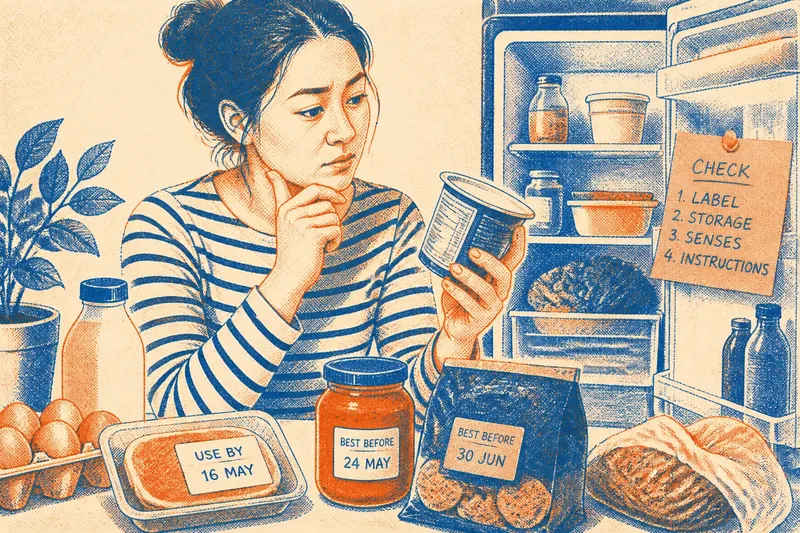
Use-by and best-before labels can leave you asking the same practical question: is this food still all right to eat? The wording points to two different decisions, so the answer depends on which date appears, how the food has been kept and what the pack says to do.
Use-by is about safety for foods that can become unsafe quickly. Best-before is about quality: after that date, a food may lose some of its expected taste or texture, but the date alone does not mean it is unsafe. Confusing the labels can lead either to needless waste or to a risky choice.
Use-by and best-before point to different decisions
Think of a use-by date as a boundary for eating the food, provided you have followed the storage instructions. Once it has passed, do not eat the food, cook it or freeze it, even if it looks and smells normal. Smell and appearance cannot reliably tell you whether food past its use-by date is safe.
A best-before date is the maker’s guide to how long the food should retain its expected quality when stored as directed. Once it has passed, you can use your senses and judgement to assess the food. A change in flavour, crispness or texture may make it less enjoyable without automatically making it unsafe.
Neither label is a substitute for the other information on the pack. Storage temperature, instructions for once opened and any special handling guidance all matter. Follow the package instructions and the relevant official food-safety guidance for your location, particularly where rules or advice differ by food.
Food is past its use-by date, but seems fine
What usually causes the confusion: People often treat the dates as interchangeable, or trust a familiar smell over the label. That is understandable: a carton can look untouched, and a chilled product may seem perfectly ordinary.
What to try: Check whether the printed date says use-by. If it has passed, do not eat the food or try to make it safe by cooking it. Put it aside for disposal, and check the fridge temperature and storage directions before buying that product again.
If you are unsure whether a printed date is a use-by date, read the words around it rather than relying on the numbers alone. The date format can vary, and another date on the pack may refer to production or a different quality mark. If the label remains unclear, consult the manufacturer or an official food-safety source rather than guessing.
A best-before date has passed and the food looks unchanged
What usually causes the confusion: The date can feel like a safety deadline, especially when it is printed prominently. But best-before refers to expected quality, not a promise that the food becomes unsafe as soon as the date passes.
What to try: First check that the food was stored as directed and that the pack is intact. Then look at it, smell it and, where appropriate, taste a small amount. Discard it if you notice mould, an unusual smell, a damaged seal or another clear sign of spoilage; do not taste food that already looks or smells wrong.
For a dry cupboard food, the issue may simply be stale flavour or a softened texture. A sealed packet of crackers past its best-before date, for example, might be safe to assess but no longer crisp. Your senses can help judge quality here, but they do not override a use-by date or make poor storage irrelevant.
Opening the pack changes what you need to check
What usually causes the confusion: The printed date is easy to remember, while the instruction to eat soon after opening is easy to miss. A date printed for an unopened pack does not automatically describe how long it remains suitable once opened.
What to try: Read the storage directions before opening, then look for wording such as “use within” a stated period after opening. Note when you opened the pack if that helps you keep track, and follow any instruction to refrigerate, reseal or use promptly. If the pack gives no clear direction, check official guidance or contact the manufacturer for that product.
Say you open a jar that says to refrigerate after opening and use within a stated period. Put it in the fridge straight away, mark the opening day if useful, and follow the pack’s time limit rather than extending it because the printed best-before date is still ahead. The observable result is a clear, product-specific reminder instead of a guess based on the unopened date.
Freezing or cooking seems like a way around the date
What usually causes the confusion: Freezing and thorough cooking can sound like general fixes, so it is tempting to assume they make any dated food safe. Timing matters: freezing is not a way to rescue food after its use-by date, and cooking does not erase every risk from mishandled or spoiled food.
What to try: If the pack permits freezing, freeze a suitable food before its use-by date and follow the manufacturer’s instructions for thawing and use. Do not eat food that has passed its use-by date on the assumption that cooking or freezing will reset the clock. For best-before foods, decide on quality and storage condition rather than treating the date as a safety cut-off.
It is not worth trying to decode a food’s safety from a “sniff test” after its use-by date, or trimming away a doubtful patch to save the rest. Those shortcuts can create confidence without answering the safety question. When food is past a use-by date, the sensible choice is to discard it.
What should you do when the date or storage history is unclear?
Does best-before mean the food is unsafe afterwards?
No. Best-before signals the period when the food is expected to retain its intended quality if stored correctly. After the date, assess its condition and discard it if there are signs of spoilage or the packaging is compromised.
Can I eat food after its use-by date if it smells normal?
No. Normal smell and appearance cannot establish that food past its use-by date is safe. Do not eat, cook or freeze it after that date.
Does the printed date still apply after I open the pack?
Not necessarily. Check for separate instructions about refrigeration and how soon to use the food after opening; those directions may set the relevant limit.
What if I do not know how the food was stored?
Do not assume the date alone settles the question, because it assumes the food was handled as directed. If safe storage is uncertain, particularly for a food with a use-by date, consult official guidance or discard it rather than relying on appearance.
Make the wording part of your everyday decision
When you bring food home, notice the label and storage instructions before putting it away. Keep chilled items at the temperature the pack specifies, and move foods that need refrigeration promptly. If you open a product, check whether its instructions introduce a new time limit.
For use-by and best-before dates, the practical distinction is straightforward: use-by guides a safety decision, while best-before guides a quality decision. Read the exact wording, follow storage directions and treat uncertainty about safety differently from a possible loss of freshness. That small pause helps you avoid both an unnecessary discard and an unsafe guess.