When Nutrition Panels Became Part of the Pack
Learn how nutrition panels became routine through changing labelling rules, and see how the history helps explain the dates, formats and gaps on packs today.
When did nutrition panels become a normal part of the pack? The short answer is that nutrition panels became familiar through a gradual shift in food-labelling rules, not one worldwide change on a single date. The timeline depends on where a product was sold, so a pack’s country of sale matters as much as its brand.
Nutrition information first appeared selectively
Early packaged-food labels chiefly identified the product and its maker. Some manufacturers chose to add nutrition details or highlight particular nutrients, but those voluntary choices did not give shoppers a consistent set of information across products.
That changed in stages. Public discussion of nutrition and the growth of processed, packaged foods increased interest in what was inside a product, while food authorities began setting rules for when nutrition information had to appear and how it should be presented.
Rules made panels more familiar, but not all at once
There is no single date when nutrition panels became standard everywhere. Requirements were introduced at different times by different countries and jurisdictions; they also varied by product, with exemptions in some cases. Without a country-specific timeline, it would be misleading to give one milestone as the answer.
The broad sequence is clearer than any universal date: optional or promotional nutrition details came first; local rules then defined required declarations and their format; and, as those rules applied to more products, shoppers increasingly encountered a dedicated nutrition panel. The nutrients, units, layout and serving information still differ between markets.
A useful way to investigate a particular pack is to check where it was sold and look for the relevant food-label rules from that jurisdiction. A label made for one market may be adapted, covered by an exemption or presented differently in another. This explains why two similar products can carry panels with different layouts.
Shared formats changed what shoppers could expect
A prescribed panel gave nutrition details a more consistent place on the pack. Instead of relying only on a maker’s choice of front-of-pack claims, shoppers could look for a declaration with specified entries. That made the information easier to locate, though it did not make every panel identical.
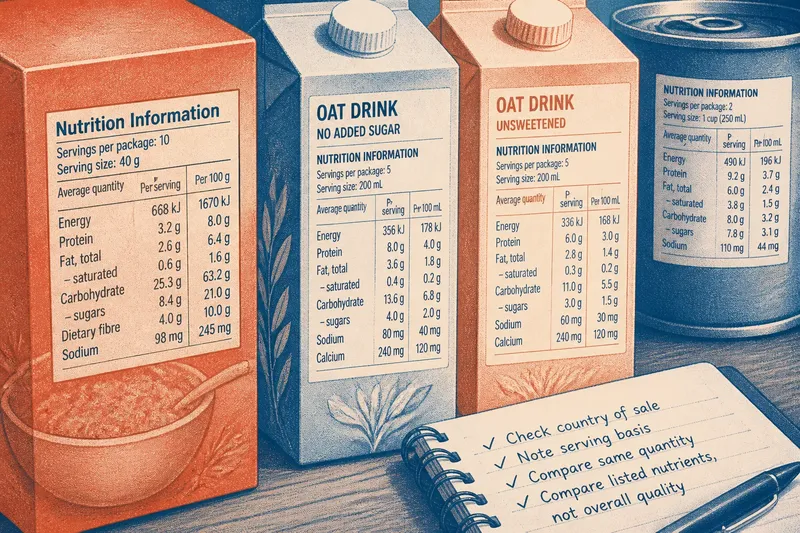
Serving basis is one important difference. A panel may list values per serving, per one hundred grams or millilitres, or both, depending on local requirements and the product. The stated serving is a label reference, not necessarily the amount a person pours or eats.
It is not worth trying to infer a product’s whole quality or suitability from a single nutrient figure. The panel has a narrower job: presenting defined nutrition information under the rules that apply to that pack.
Compare two panels using the same quantity
For a fair comparison, first find a shared basis, such as values per one hundred millilitres. If only one panel gives that basis, calculate the other only when you have its serving volume and the relevant figures; otherwise, the comparison is incomplete. Keep the result tied to the nutrients listed, rather than turning it into a broad judgement about either product.
Say you are choosing between two oat drinks for a recipe. Imagine, purely as invented label values, that Drink A lists 3 grams of protein per 100 millilitres, while Drink B lists 4 grams per 200-millilitre serving. Divide Drink B’s stated amount by two to obtain 2 grams per 100 millilitres; on that label entry, Drink A has the higher value for the same volume. This answers only the protein comparison, not which drink is preferable for every recipe or dietary need.
Questions about when nutrition panels became common?
When did nutrition panels become mandatory?
There is no universal date: each country or jurisdiction set its own requirements, and the rules may differ by product category. To identify a specific milestone, look up the food-labelling authority and legislation for the market in question.
Why do some products have no nutrition panel?
Local rules may exempt certain products or types of packaging, and requirements differ between markets. If the omission affects a decision, check the rules where the product is sold or contact the manufacturer.
Why do similar products have different panel formats?
They may be labelled for different markets, where required nutrients, units and presentation rules differ. Check the country of sale and the basis used for each value before comparing the panels.
Does the presence of a panel mean a product is healthy?
No. A panel supplies specified nutrition details; it does not make an overall judgement about taste, ingredients, suitability or how a food fits into a meal.
Check the pack before drawing a historical conclusion
For a particular product, note its market, the panel’s units and whether the figures are given per serving or per a common quantity. Those details help explain what the label tells you and why it may differ from another pack.
Nutrition panels became part of everyday packaging through successive local rules, rather than one global switch. Keeping that history in mind makes the main point practical: a familiar format reflects the requirements of its market, so check those requirements before treating one pack as evidence of when panels became standard everywhere.